
Crossflow Blower Heaters for Industrial Drying & Dehumidification: A Practical Path Away from Gas
Industrial drying and dehumidification demand uniform airflow, tight temperature control, and reliability. That’s exactly where crossflow blower heaters excel. Unlike point-jet or axial process heaters, a crossflow module creates a wide, even “curtain” of heated air across the length of the process. This type of blower is ideal for electronics drying after wash, flux-removal rinse, conformal-coat line prep, cabinet/enclosure dehumidification, and gentle moisture control over sensitive assemblies.
Why Choose Crossflow for Electronics and Enclosure Work?
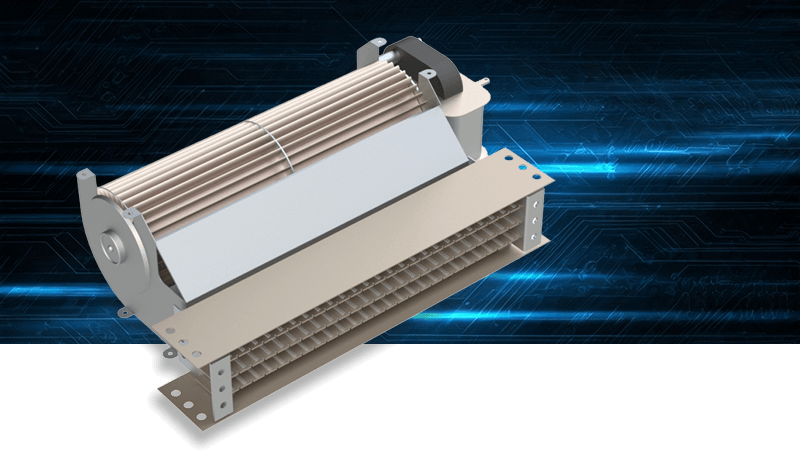
Electronic component manufacturing processes need heat that’s distributed (to avoid hotspots on boards and connectors), controllable (to protect adhesives, coatings, plastics), and clean (no combustion byproducts). A crossflow heater paired to its blower delivers laminar, low-turbulence flow across the full width of the product or opening. An example application of this could be across a conveyor span or the face of an electronics cabinet door. TUTCO-Farnam’s crossflow blower heaters are designed specifically for this. They bolt directly to the blower outlet, are available in standard lengths from 5.55″ (≈ 14.1 cm) up to 14.98″ (≈ 38.0 cm), and can be built with single/dual wattage or voltage. Additionally, the systems are fully customizable allowing for integrated thermal fuses or hi-limit thermostats for protection. That combination makes them a robust “drop-in” building block for drying and dehumidification equipment. In enclosures and control cabinets, moisture control is often the difference between reliable uptime and potential scrap. Vendors that focus on enclosure climate such as STEGO and DBK, document how panel heaters and hygrostats prevent condensation, corrosion, and electrical shorts. AutomationDirect’s enclosure-thermal overview highlights hygrostats that energize a heater when relative humidity (RH) rises, directly targeting dew point events inside the cabinet. The result is a simple, effective control scheme with your crossflow module ducted directly into a panel or plenum that serves multiple cabinets.
Why Choose TUTCO-Farnam for your Crossflow Build
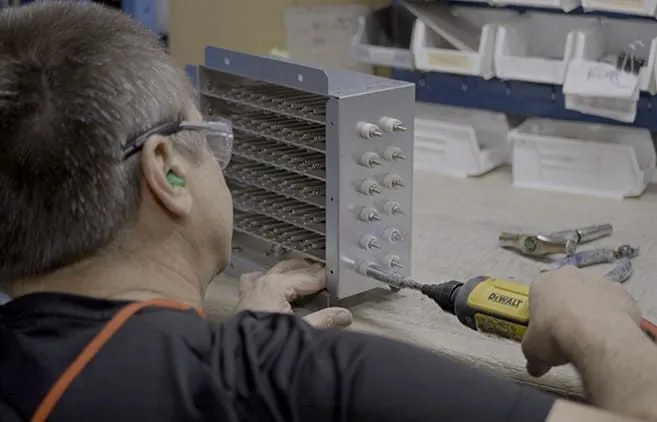
TUTCO-Farnam designs crossflow heaters that mount directly to the blower outlet, reducing extra parts and minimizing pressure-drop issues. Their assemblies are built with UL-recognized components and can be equipped with integrated protection features, making compliance and system integration far simpler for OEMs and process engineers. What sets Farnam apart is their focus on drying and dehumidification applications. These crossflow blower heaters are not adapted from other designs but engineered specifically to deliver uniform, reliable performance in environments where consistent moisture control is critical. For facilities looking to replace gas or outdated heating solutions, Farnam provides purpose-built, dependable electric crossflow options that are proven in industrial service.
Proof points: Efficiency and Reliability Gains Users are Seeing
Condensation Prevention and Energy Savings
STEGO’s latest enclosure heater (CS 032) reports up to 23% energy savings via smarter control while maintaining reliability. This is a useful benchmark for what good airflow + good controls can deliver in moisture-management duty. Crossflow modules paired with similar controls and sensing can target the same outcome at the process level.
Economics of Switching from Gas to Electric
While not a crossflow-specific example, MHI’s Airtorch case analysis illustrates the macro trend: replacing a 14.2 MW gas hot-air heater with a 12 MW electric system yielded an estimated $3 million/year operating cost reduction (before carbon costs) under continuous operation. The physics are similar for any forced-air industrial heater: go electric, eliminate combustion losses/air handling, enable precise on/off modulation, and you often lower both energy and maintenance costs.
Broader Technical Bodies Echo the Opportunity
DOE/EPRI and other research groups identify direct electrification of process heat as a key lever for cost and emissions performance at low-to-mid temperatures. Manufacturers know that this is the exact temperature range where electronics drying and dehumidification sit, making it of utmost importance.
How Farnam’s Crossflow Blower Heaters will Help you Transfer from Gas to Electric
If you’re using small gas burners, IR arrays, or indirect gas heaters for low-temperature drying, TUTCO-Farnam’s crossflow blower heaters give you a straightforward electrification path.
One-Piece Crossflow Module
The heater is designed to mount directly to the crossflow blower, eliminating extra brackets or duct hardware, simplifying mechanical integration on existing lines or cabinets. Standardized lengths make it easy to “tile” multiple modules for wider zones.
Right-Sized Power with Built-in Protection
Factory-matched wattage/voltage options and optional thermal fuses/hi-limits protect the assembly if airflow is obstructed. Dual-wattage versions let controls step power for warm-up vs. hold without overshoot.
Cleaner, Safer Workspaces
Electric air heat means no combustion air, no flame safeguards or gas trains, and no NOx/CO in the airstream. This is crucial around sensitive electronics and clean production areas on top of providing a safer work environment to your production team.
Precision Control
Pair a crossflow zone with temp sensors and a hygrostat (for moisture-triggered assist), and you’ll hit RH and temperature setpoints with less energy. This is the same logic behind enclosure hygrostats automatically enabling panel heat to avoid potential dew point issues.
Lower Maintenance & Faster Changeovers
Electric elements have no burners to tune, no exhaust, and far fewer moving parts. Swapping modular crossflow units lets you change width/CFM quickly for new SKUs or board formats.
Where Crossflow Blowers Shine in Practice

Post-wash PCB and Harness Drying
A narrow conveyor with a crossflow “curtain” over the belt delivers fast surface moisture removal with low part disturbance.
Coating/Encapsulation Prep
Even, gentle pre-heat improves viscosity and wet-out without risking hotspots on plastic connectors.
Enclosure/Cabinet Moisture Control
A crossflow unit ducted to a small plenum can serve multiple cabinets; sequence it with RH sensors to run only when needed. (Enclosure-heating vendors provide the sensing playbook.)
Benefits to Expect when Switching from Gas
Energy & Operating Cost
Electric heaters convert nearly all input power to heat at the point of use. You eliminate combustion inefficiencies, standby losses, and make-up air penalties. Real-world studies on hot-air electrification show meaningful OPEX reductions depending on tariffs and duty cycle. At scale, they can be dramatic (see the Airtorch example). Even at modest scales typical of electronics lines, tighter control and faster start/stop reduce wasted BTUs between batches.
Process Yield & Throughput
A uniform crossflow field helps dry evenly across the product width, reducing rework from moisture-related defects, such as under-cured coatings and entrapped moisture. Panel-heating case work consistently ties moisture control to fewer failures in service.
Safety & Compliance
No combustion means no flame hazards, no gas piping permits, and simpler ventilation. For many facilities, this removes a permitting bottleneck and shortens changeover timelines. Enclosure/heater vendors emphasize the safety margin of self-regulated PTC technologies when applicable.
Decarbonization & ESG
Electrification lets you pair heat with cleaner electricity over time. Reports from EPRI, RAP, and others identify low-to-mid-temperature process heat as a prime early mover for decarbonization. This is an easy win for sustainability reporting and customer audits.
Implementation Blueprint
Define the Airstream
Match blower length to product width/opening, and specify CFM and exit velocity for the gap to your part or cabinet face. TUTCO-Farnam supports common lengths (5”, 7”, 10”, 12”, and 15”) and custom solutions if needed.
Size the Heat
Work from your required ΔT (temperature rise) and line speed or enclosure volume. Choose single vs. dual wattage for warm-up/hold, and confirm supply voltage and available amperage.
Add Smart Controls
Use a thermostat/RTD for temperature and a hygrostat for RH-triggered assistance. In cabinets, this strategy is well-documented and keeps energy use low while preventing dew. The same logic scales to process plenums.
Engineer for Safety
Include airflow switches, thermal fuses/hi-limits, and interlocks. Farnam offers integrated protection that simplifies panel design and certification.
Validate & Tune
Start with a short Design of Experiments (DOE) to map surface temperatures and dry-down times across the product width, then lock in setpoints. Expect to see lower energy per unit once you right-size wattage and minimize over-temperature margins.
Convert from Gas to Electric with TUTCO Farnam's Crossflow Blower Heater
 Define the Airstream Match blower length to product width/opening, and specify CFM and exit velocity for the gap to your part or cabinet face. TUTCO-Farnam supports common lengths (5”, 7”, 10”, 12”, and 15”) and custom solutions if needed. Size the Heat Work from your required ΔT (temperature rise) and line speed or enclosure volume. Choose single vs. dual wattage for warm-up/hold, and confirm supply voltage and available amperage. Add Smart Controls Use a thermostat/RTD for temperature and a hygrostat for RH-triggered assistance. In cabinets, this strategy is well-documented and keeps energy use low while preventing dew. The same logic scales to process plenums. Engineer for Safety Include airflow switches, thermal fuses/hi-limits, and interlocks. Farnam offers integrated protection that simplifies panel design and certification. Validate & Tune Start with a short Design of Experiments (DOE) to map surface temperatures and dry-down times across the product width, then lock in setpoints. Expect to see lower energy per unit once you right-size wattage and minimize over-temperature margins.
