
CRAC vs CRAH: What’s the Best Cooling Solution for Hyperscale Data Centers?
In hyperscale data centers, thermal management is mission-critical. As power densities increase and energy efficiency becomes a competitive advantage, choosing the right cooling solution can directly impact performance, uptime, and operating costs. Two commonly deployed systems—CRAC (Computer Room Air Conditioner) and CRAH (Computer Room Air Handler)—serve similar purposes but operate in fundamentally different ways. Understanding their distinctions is key for any data center engineer, architect, or facilities planner.
What is a CRAC Unit?
CRAC units are self-contained air conditioners that use direct expansion (DX) systems with refrigerant to cool air inside a data hall. They function similarly to residential or commercial AC units.
- Cooling method: Refrigerant-based
- Internal components: Compressor, condenser, evaporator coil, and fans
- Heat rejection: Typically to an outdoor condenser or dry cooler
- Control: Maintains temperature and humidity using integrated sensors
Because they’re relatively easy to deploy, CRAC units are often used in smaller data centers, edge computing environments, and modular data pods.
What is a CRAH Unit?
CRAH units use chilled water supplied by a centralized cooling plant to condition the air. Instead of refrigerant, they rely on water-to-air heat exchangers and fans to move large volumes of air across chilled water coils.
- • Cooling method: Water-cooled via external chiller plant •
- Internal components: Chilled water coil, EC fans or blowers, control valves
- Heat rejection: Heat is transferred to water, which is cooled by external chillers
- Control: Integrates with building automation and BMS systems for precision airflow and temperature management
CRAH units are the preferred choice in hyperscale and large colocation environments due to their superior efficiency, scalability, and ability to integrate with economization systems.
Why CRAH is Ideal for Hyperscale Data Centers
Hyperscale environments demand maximum cooling efficiency, flexibility in load distribution, and seamless integration with advanced control systems. CRAH units shine in these areas:
1. Energy Efficiency
CRAH units, when used with water-side economizers or free cooling loops, can deliver significant energy savings compared to CRAC systems. Since they avoid the inefficiencies of distributed compressors, they allow the facility to hit lower PUE (Power Usage Effectiveness) targets.
2. Scalability
As workloads scale or server rack densities increase, CRAH systems allow for easy expansion by adding more chilled water capacity or additional air handlers. This flexibility is essential for hyperscale growth.
3. Better Integration
CRAH units integrate tightly with Building Management Systems (BMS) , allowing operators to fine-tune temperature, humidity, and airflow based on real-time sensor data. Advanced CRAH systems often use variable speed EC fans , adjusting airflow dynamically for optimal performance.
4. Redundancy and Reliability
In hyperscale designs, redundancy is non-negotiable. CRAH-based systems allow for N+1 or 2N redundancy in chilled water plants and air handlers, ensuring high availability even during component failures or maintenance.

Side-by-Side Comparison
| Feature | CRAC (Computer Room Air Conditioner) | CRAH (Computer Room Air Handler) |
| Cooling Medium | Refrigerant (DX) | Chilled Water |
| Heat Rejection | Cooling Medium | External chiller plant |
| System Type | Self-contained | Part of centralized cooling |
| Efficiency | Moderate | High, especially with economizers |
| Scalability | Limited | Excellent |
| Typical Deployment | Small/edge data centers | Hyperscale/enterprise sites |
| Maintenance | Simple but more frequent | Requires skilled technicians |
| Airflow Management | Moderate control | Requires skilled technicians |
 Electric Heaters Used in Thermal Oxidizers
 Understanding Load Banks and Resistors for Power Testing
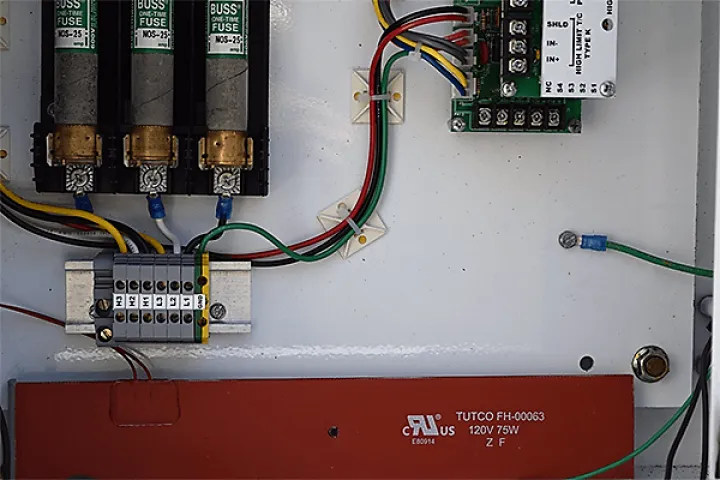 Enclosures and Enclosure Heaters
 Inline Industrial Duct Heaters