Cold Spray, and CO2 Snow Cleaning
TUTCO Farnam Heaters excel in CO2 Snow Cleaning
TUTCO Farnam specializes in the design and manufacture of preheaters engineered for cold spray cleaning, also referred to as CO2 snow cleaning. Our heaters are crucial in the process for elevating the temperature of carrier gases, such as nitrogen, helium, or custom gas mixtures, to a precisely controlled target temperature under high pressure. This preheating process is a fundamental step, as the heated gas subsequently merges with a solid deposition powder. The gas-powder mixture is then accelerated to supersonic velocities through a de Laval-type nozzle, a critical action for the successful deposition of the coating.
To meet the rigorous demands of cold spray systems, these air heaters are designed to rapidly and consistently achieve their target temperatures. A key technical requirement, that can only be achieved with the heater, is their ability to withstand extremely high watt densities, which is essential for delivering maximum thermal energy within a compact volume. This high-power density is a direct consequence of the technical requirement needed for rapid heating rates and efficient thermal transfer within the confined space of the cold spray system, which our heaters proficiently provide.
The Cold Spray Cleaning Process
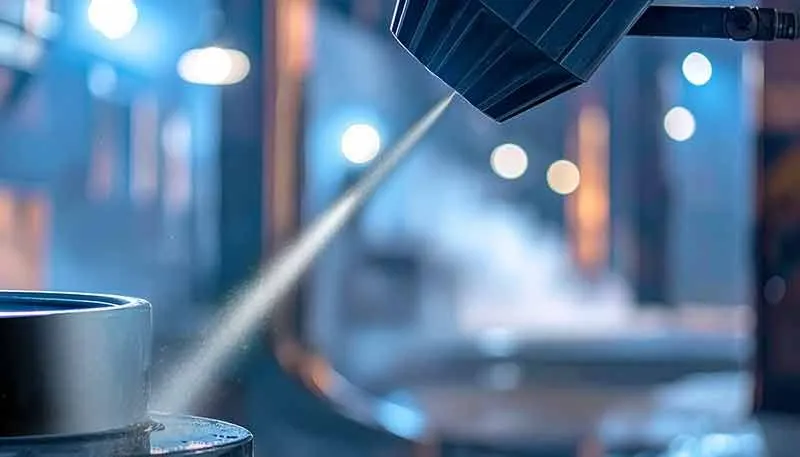
During the cold spray process, the deposition material exits the nozzle at supersonic velocity, impacting the substrate with significant kinetic energy. Upon impact, the high-velocity particles and the substrate surface undergo plastic deformation. The initial impact of a single spherical particle creates a crater-like depression on the substrate. Simultaneously, the particle itself flattens and spreads radially, filling and conforming to the newly formed cavity. This mechanical interlocking process, occurring at the microstructural level, creates a robust mechanical bond between the particle and the substrate with no thermal effects.
This bonding mechanism is a key advantage in the application of cold spray technology. Since the materials are not melted, they retain their original microstructures and metallurgical properties. This allows for the successful deposition of a wide range of materials, including those with low melting points or those that are sensitive to oxidation. Furthermore, the absence of a thermal phase change at the interface enables the bonding of dissimilar materials. Employing this method yields a significant advantage over competing thermal spray processes that rely on melting and chemical change to form a bond.
Cold spray itself is a solid-state coating deposition process. Unlike thermal spray methods that melt the feedstock powder, cold spray relies on the kinetic energy of the particles. The process begins with the introduction of powdered materials—including metals, ceramics, and composites—into a stream of hot, high-pressure gas. The powder particles are accelerated to high velocities, and upon impact with the substrate, they deform and bond without a phase change, building up a dense, thin layer of material.
Advantages of Cold Spray Cleaning
- Non-Abrasive: It does not scratch or damage delicate surfaces, making it ideal for optics, electronics, and precision machinery.
- Residue-Free: The CO2 sublimates completely into gas, leaving no chemical residue, liquid, or waste products.
- Environmentally Friendly: It uses a common, non-toxic, and relatively inert substance.
- Effective: It can remove a wide range of contaminants, including particles, oils, films, and organic residues.
- Dry Process: Since it uses no liquid solvents, it is suitable for cleaning moisture-sensitive materials.
- Semiconductor Manufacturing: Cleaning wafers and masks.
- Aerospace: Cleaning sensitive components and optical surfaces.
- Medical and Pharmaceutical: Cleaning instruments and sterile surfaces.
- Optics: Cleaning lenses, mirrors, and delicate optical components without scratching them.
- Electronics: Cleaning circuit boards and other electronic components.
Cold Spray cleaning is widely used in industries where contamination control is critical.
Let’s Talk About Your Cold Spray, CO2 Cleaning Needs
Cold spray cleaning offers unmatched precision and protects delicate surfaces while effectively removing contaminants without leaving residue or causing damage. TUTCO Farnam’s custom-engineered preheaters are built to meet the exact temperature, pressure, and performance requirements of your cold spray system, ensuring consistent results and maximum efficiency. From improving process control to extending equipment life, our heaters are designed to integrate seamlessly into your application—whether you’re building new systems or optimizing existing ones. Partner with us to deliver cleaner, safer, and more reliable results for your critical cleaning operations.
 Outdoor Enclosure
 Flexible Silicone Rubber Heaters
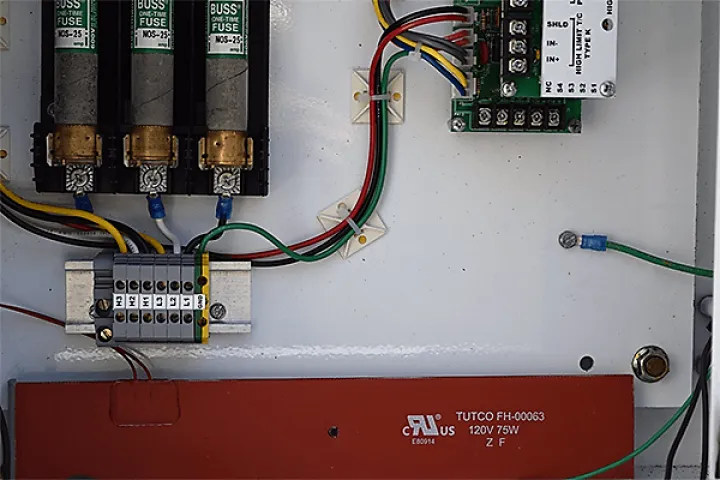 Enclosures and Enclosure Heaters Flexible Heaters